Advanced Beyond‑Line‑of‑Sight (BLOS) Tactical Communication System
An integrated SDR‑based multi‑waveform suite using stratospheric scatter and ultra‑refraction for ultra‑long‑range, anti‑jamming connectivity in complex electromagnetic environments.
Overview
Advanced Beyond‑Line‑of‑Sight (BLOS) Tactical Communication System. The Skymu ELINC Series is a tactical communication ecosystem designed to break the constraints of the Earth's curvature. Using tropospheric scatter and ultra‑refraction, it delivers two to three times the communication range of standard radios, reaching units that are physically out of sight of each other.
Built on the latest SDR architecture, the system combines hybrid digital coding, adaptive low‑noise demodulation and multi‑antenna spatial anti‑jamming. From fixed and ship‑borne stations to vehicle, man‑pack and handheld sets, one waveform family serves tactical data links, emergency response and electronic warfare operations.
Working Principle
Bend the signal, not the line of sight. Signals are launched into the troposphere, where scatter and super‑refraction redirect part of the energy back to earth far past the geometric horizon — the basis of BLOS reach over sea, plain and mountain terrain. Inside the radio, a fully independent SDR platform applies hybrid digital coding with adaptive low‑noise demodulation to keep receiver sensitivity and voice clarity high at the edge of coverage.
In contested spectrum, ECCM takes over: high‑speed frequency hopping, spread spectrum and multi‑antenna spatial anti‑jamming work together against interception and jamming, while the waveform layer fuses ultra‑long‑range narrowband links with high‑speed wide‑band data so one network carries both voice and mission data.
Product Lineup
Ten interoperable models across five deployment forms — stations, man‑packs, handhelds, HF long‑range sets and receivers, all sharing the BLOS waveform family.
- NT‑899 Base Vehicle / Ship Station: tropospheric‑scatter BLOS digital station giving stable ultra‑long‑range links in complex electromagnetic environments, with flexible vehicle or ship installation.
- KD‑240 High‑Performance Vehicle / Ship Station: wide‑band integrated anti‑jamming station that fuses spatial anti‑jamming with time and code domain diversity for contested environments.
- NT‑876 Base Man‑pack Station: advanced digital signal processing with breakthrough power consumption and lightweight design, suited to prolonged field operations.
- HT‑200 High‑Performance Anti‑Jamming Man‑pack: fast frequency hopping, spread spectrum and ad‑hoc networking, optimised for BLOS waveforms under electronic warfare conditions.
- NT‑68 Base Walkie‑talkie: pairs with vehicle or man‑pack stations, with ultra‑low power consumption and a breakthrough long‑range capability.
- HT‑7200 HF Multi‑Waveform Station: high‑Q low‑noise RF chips with smart multi‑waveform selection; surface wave and sky wave together eliminate shortwave blind spots.
- HT‑300 High‑Performance Handheld Radio: SDR platform with frequency hopping, spread spectrum and ad‑hoc networking for stable voice and data in electronic warfare.
- HT‑400 High‑Performance Walkie‑talkie: high sensitivity in a compact body, with communication reach well beyond conventional handhelds and extended standby time.
- TSS‑21 8‑Channel Narrow‑band Receiver: VHF communication reconnaissance, electronic countermeasures and spectrum monitoring.
- TSS‑30 Wide‑band Receiver: signal guarding, reconnaissance and electronic warfare, with wide instantaneous bandwidth and strong anti‑jamming and notch filtering.
Typical Applications
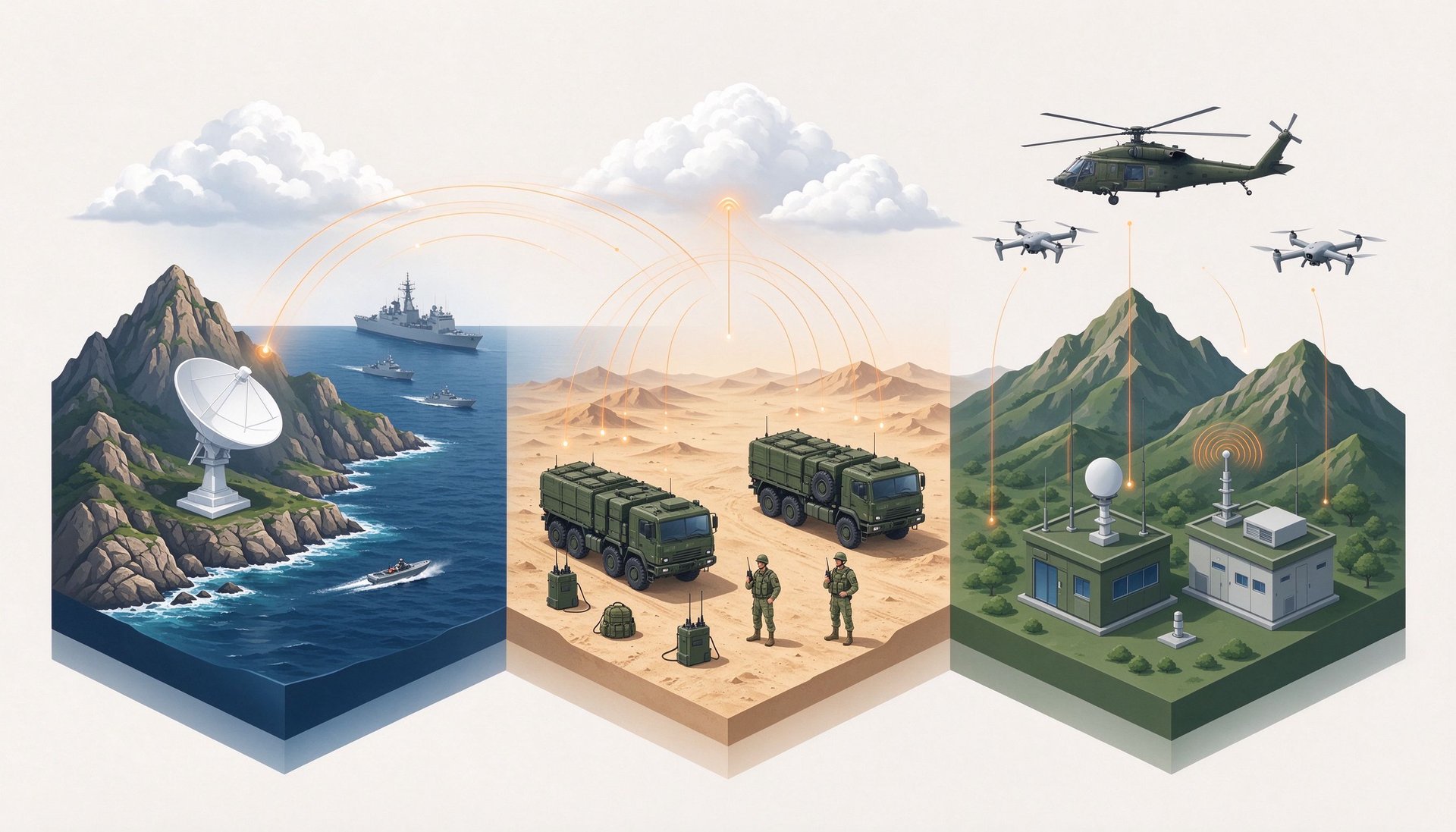
- Maritime BLOS Communication: anti‑jamming voice and data between coastal command centres, deep‑sea warships and speedboats for patrols, escorts and joint exercises — overcoming the curvature limit at sea.
- Ground Tactical Mobile Network: seamless multi‑level interconnection between vehicle stations, man‑packs and handhelds across mountain, plain and urban terrain, forming a flat three‑dimensional tactical network during rapid manoeuvre.
- Ground‑to‑Air & Air‑to‑Air Data Link: stable links to helicopters and UAVs alongside the ground network, extending the same waveform family into the air layer.